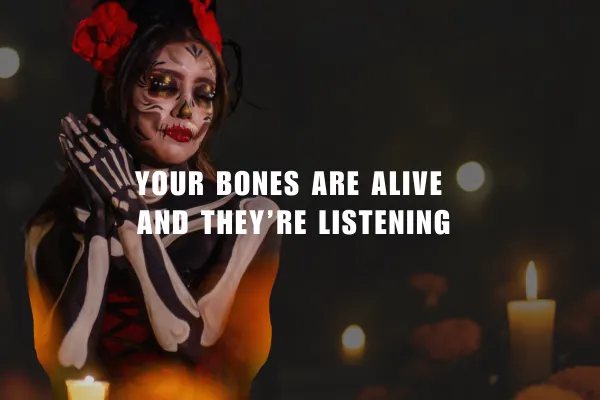
Your Bones Are Alive... and They’re Listening
When you picture your bones, what do you see?
My guess is something like a coat hanger. Or one of those plastic skeletons in the Halloween window. Something rigid, inert, quietly holding everything else up while the rest of you gets on with living.
I understand why we think that way. It’s essentially what we were shown at school... a diagram, named parts, done.
But that picture leaves out something rather extraordinary. And once you know it, I don’t think you’ll be able to un-hear it.
Your bones are alive.
Living tissue, not scaffolding
Right now, as you read this, your skeleton is doing something.
It’s breaking down and rebuilding itself in a constant, dynamic cycle that never fully stops. It has its own maintenance crew of cells; osteoblasts, the builders, laying down fresh bone tissue in response to load and movement; and osteoclasts, the removers, breaking down old or damaged bone so it can be replaced.
This process is called bone remodelling. And it means your skeleton today is not the skeleton you had ten years ago. The material has been replaced, layer by layer, over and over.
Bone also has layers. The outer cortical bone is dense and gives bone its structure. Inside that, particularly in the larger bones, is trabecular bone: a clever lattice structure, like scaffolding inside scaffolding, designed to absorb and distribute force. Strong, lightweight, and deeply intelligent.
Why menopause changes everything
In a healthy system, the builders and removers work in balance.
This is where menopause becomes significant.
One of oestrogen’s many roles is to regulate that balance, essentially keeping the osteoclasts in check. When oestrogen levels drop during perimenopause and menopause, that signal weakens. The removers can start to outpace the builders.
This is why one in two women over fifty in the UK will be affected by osteoporosis.
Not because they did anything wrong. But because nobody told them this was happening, or what they could do about it.
That’s what this series is for.
The periosteum: your bone’s first line of feeling
Wrapping the outside of almost every bone in your body is a membrane called the periosteum.
It’s not just a wrapper; it’s a living, active layer with its own blood vessels, its own nerve supply, and its own stem cells ready to build and repair.
It has two layers. The outer fibrous layer provides structural strength and is where tendons and ligaments attach.
The inner cambium layer sits right against the bone and houses the progenitor cells responsible for bone growth and healing.
One thing worth knowing: the periosteum is the most pain-sensitive part of your bone. More sensitive than the bone tissue itself.
Which is why a fracture hurts so acutely, and why a knock to the shin lands so sharply. The periosteum is paying attention. It’s the bone’s first line of feeling.
The web that connects it all: fascia
The periosteum connects bone to fascia; the continuous connective web that surrounds and weaves through everything else in the body.
Every muscle, every organ, the spaces in between, all connected without interruption.
Think of it like the inner lining of a wetsuit running through your entire body.
The tendons, ligaments and fascial layers of your muscles attach to the outer periosteum before connecting into bone, literally continuous with each other, like a threshold between rooms.
There is no hard border. Just a gradual transition from one living tissue into another.
There is emerging scientific thinking that bone itself may be best understood as ossified fascia; the same continuous connective tissue, just mineralised into structure.
Still debated, but I find it a beautiful idea. Your bones are not a separate solid thing inside a soft body.
They are part of one continuous, living, communicating whole.
The woman who sings over the bones
In a recent embodiment practice, I was guided to breathe into the different layers of my body, into the muscle, the fascia, and finally the bone.
And in that stillness, something settled. A sense of being held by my own architecture. Ancient and strong and mine.
It brought to mind the story of La Loba from Clarissa Pinkola Estés, the old wolf woman who wanders the desert collecting the bones of wolves, then sings over them until flesh returns and the wolf leaps free, transforming at the edge of the desert into a woman, laughing and running.
Estés describes this as a metaphor for the deep feminine work of remembering, gathering the scattered parts of yourself and singing them back to life.
So much of what I do with the women I work with is exactly that.
The strength training, the nutrition, the breathwork... all of it practical, all of it grounded in science.
But underneath it is an invitation to remember that you are already whole.
All the parts of you are there. Sometimes they just need to be gathered up. Sung back together.
Given permission to run free.
A small invitation
Before part two next week, where we get practical about movement, strength and load... I want to leave you with something simple.
Find a quiet moment this week.
Sit still.
Take a breath.
And see if you can feel into your own structure.
The weight of your bones in the chair.
The length of your spine.
The breadth of your ribcage as it rises and falls; expands and contracts.
You don’t have to do anything with it. Just notice.
Maybe say hello.
Your bones have been holding you up your whole life.
They might appreciate the acknowledgement.
Listen to Episode 130 of Rooted in Presence wherever you get your podcasts. Part 2: Lead With Your Bones is live next week. And if you’d like to explore bone health and strength training as part of your midlife wellness, come and find me at Still Space Hull.


