Life After Burnout: When Your Old Routines Stop Fitting and How to Rebuild
There’s something I wish someone had said to me about three years ago, when everything started to shift.
I wish someone had told me:
"Life as you know it is over.
But that’s okay.
Because there’s a life on the other side of this that you can’t imagine yet, and it’s going to be more you than anything you’ve lived so far."
That’s a terrifying thing to hear.
Because when you’re in the middle of burnout, when your routines have crumbled and your identity along with them, the idea that something better is waiting feels like something that happens to other people.
Not YOU.
But I’m standing on the other side of a lot of change now.
And I can tell you: the life I couldn’t imagine is the one I’m living.
Which means the question I keep asking is:
if I could get here, what might be possible for the women I work with who are standing at their own threshold right now?
When Consistency Becomes A Cage
We’re sold a particular story about consistency.
Build the habit.
Become the person.
Show up every day.
And for a while, that story works.
It builds momentum, creates identity, feels like progress.
But here’s what that story leaves out.
When life fundamentally changes, and burnout, menopause, loss, major life transition will all do this... the routines you built for the old version of your life stop fitting.
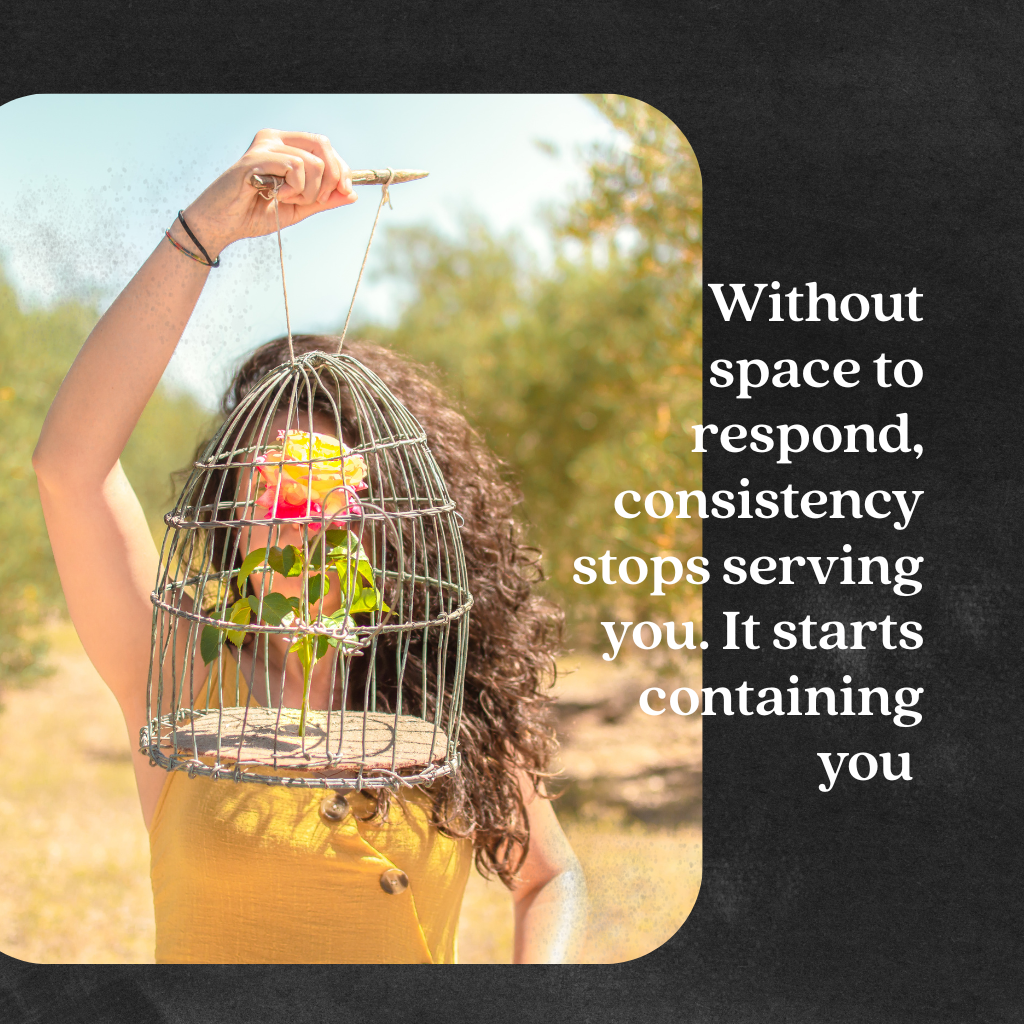
The contract you made with yourself was made by someone who no longer exists in quite the same way.
And instead of recognising that as information; as a signal that something needs to change, most of us interpret it as failure.
We weren’t consistent enough.
We didn’t try hard enough.
We let ourselves down.
But the routines didn’t fail you. They just belonged to a season that has passed.
Remembering Who You Are
When I was five years old I decided I wanted to be the first female Catholic priest (looking back this sounds ridiculous to me but there is actually a thread).
Not for religious reasons... but because it felt deeply unfair that women couldn’t be.
I had something to say. I had something to offer. And I didn’t understand why that wasn’t enough.
I’m not religious now. But that five-year-old knew something important.
She knew she had something to give that needed to be heard. But somewhere along the years of being told to be sensible and realistic, that knowing got quieter.
What I’ve discovered through burnout and rebuilding is that a lot of what I thought was growth was actually recovery. Recovery of parts of myself that were always there... just buried under decades of conditioning.
So when I think about consistency now, as a coach, I’m less interested in who you’re becoming.
I’m more interested in who you were before the world decided who you couldn’t be.
Because that’s often where the most important information lives.
Consistency as a Conversation
Allow me to share with you a reframe that changed everything for me.
Consistency isn’t a contract. It’s a conversation.
A contract is fixed. It holds you to an agreement made by a version of you that may no longer exist.
A conversation is ongoing.
It asks: what do I actually need right now?
Not what did I used to need. Not what should I need.
What does this version of me, in this season, with this body and this life... what do they need?
That question sounds simple. It isn’t always.
Because there’s a real difference between genuinely listening to your body and using self-compassion as a cover for avoidance.
I know both. I’ve lived both.
For me, genuine need tends to feel quiet and settled.
Resistance tends to feel agitated and story-driven; full of reasons and justifications.
And usually, what I’m resisting is smaller than I’ve made it.
Self-care doesn’t always need to be a whole production.
Sometimes it’s five minutes. Sometimes it’s the scaled-back version of the thing, not the full version or nothing.
Perfectionism loves to present itself as standards. But a lot of the time it’s just a very effective way of not starting.
Rebuilding Doesn’t Mean Returning To Old Patterns
After my burnout, I lost a significant amount of the strength I’d built.
The training routine I’d been proud of. The identity I’d built around being someone who moved in a certain way.
Rebuilding has meant something different.
Not returning to what was... because I’m not the same person in the same season.
But finding anchor points that belong to who I am now.
Movement that fits my current capacity.
Nourishment that works for the life I actually live, not the life I used to live.
Routines that breathe rather than cage.
The same is true for the people I work with.
I no longer coach people towards a fixed standard.
I coach them towards a practice that moves with them... we notice what emerges and adapt when life changes.
We choose practices that hold them through the transitions rather than demanding they perform consistency they don’t have capacity for.
For Anyone at a Threshold
If you’re in the middle of a transition right now... if your old routines have crumbled and you’re not sure how to rebuild; I want to say something directly.
The fact that the old structure no longer fits is not a failure.
It’s information.
It’s your life telling you that something has changed and the old agreement no longer applies.
You might not be able to see the other side yet.
That’s okay.
The not-knowing is part of the threshold.
But I can tell you from experience that the life waiting on the other side of that not-knowing can be more you than anything you’ve lived so far.
Five-year-old me had a lot figured out. I’m still catching up with her.
This blog was created from my latest podcast episode. Listen to Episode 136 of Rooted in Presence wherever you get your podcasts.
And if you’d like support rebuilding your routines and your sense of self after burnout or a major life shift, come and find me at Still Space Hull, online or in person.


