Lead With Your Bones (Part 2): Why Strength Training is the Most Powerful Thing You Can Do for Your Skeleton
Based on Rooted in Presence Podcast: Episode 131 | Lead With Your Bones, Part 2 of 3
I want to start somewhere that might surprise you.
Not in a gym. But In a hospital.
For ten years I worked as a dietitian in a busy NHS hospital.
Routine operations, critical illness, emergency admissions, I saw a huge range of health conditions across that decade.
And one thing became impossible to ignore.
The patients who came in with more muscle on their bodies did better.
Consistently.
Whether they were recovering from planned surgery or fighting for their lives in critical care; the ones who had built a stronger foundation going in had more to draw on when things got hard.
The road back was shorter, more possible, more complete.
The patients who arrived with less muscle, lower bone density, less resilience?
Their recovery was harder. Longer. Sometimes not possible in the way they’d hoped (or at all).
That pattern, played out again and again over ten years, changed how I think about everything I do now.
Because what I witnessed wasn’t just about illness. It was about reserves.
Your bone bank.
Your muscle bank.
The physical foundation that means when life throws something at you (and it will) you have something to fall back on.
Why Load is the Signal Bones Need
In my last blog we talked about bone as living tissue, constantly remodelling through a cycle of breaking down and building up.
The key driver of the building side, the osteoblasts, is mechanical load.
Stress on the bone, in the good sense.
The kind that comes from your muscles pulling on it, from impact, from weight.
When you load a bone, you send a signal. The osteoblasts respond: there is demand here. And they get to work.
Over time, consistent loading leads to denser, stronger, more resilient bone tissue.
Remove the load; through immobility, illness, or a very sedentary lifestyle, and the signal goes quiet.
This is why astronauts lose significant bone density in space. No gravity, no load, no signal. It’s also why getting people moving after surgery is so important.
The body needs to know it’s still needed.
The Muscle-Bone Conversation
There's something that doesn’t get talked about enough.
Muscle and bone are not separate systems. They are in constant communication.
Muscles attach to bone via tendons. Every time a muscle contracts, it pulls on the bone, and that mechanical tension is one of the primary signals that drives bone remodelling.
You literally cannot build strong bones without strong muscles. They are dependent on each other.
But it goes further.
Muscle tissue produces signalling molecules called myokines that travel through the body and directly influence bone metabolism.
Exercise doesn’t just load the bone mechanically. It sends chemical messages that actively support bone formation.
The two systems are in conversation all the time.
This is why strength training is particularly powerful for bone health, more so than walking alone, though walking absolutely counts.
Resistance training places direct load on the bones, stimulates myokine release, and creates the specific signal that tells your skeleton: there is demand here. Meet it.
For women in perimenopause and menopause, when oestrogen’s regulatory role in bone remodelling is declining, this mechanical signal becomes even more important.
You are providing an alternative input to a system whose primary regulator has shifted.
You are telling your bones they are still needed.
What Actually Counts
Resistance training; lifting weights, resistance bands, bodyweight exercises like squats, lunges and press-ups, is the gold standard.
If you’re not already doing some form of this, it is genuinely one of the most powerful investments in your future health I know of.
And I say that as someone who spent a decade watching what happens to bodies that didn’t have this foundation when they needed it most.
Impact also matters. Walking, dancing, stair climbing.. anything that puts your body weight through your skeleton.
Low-impact activities like swimming and cycling are wonderful for joints and cardiovascular health, but they don’t load the bones in the same way.
If swimming is your main activity, perhaps it's time to consider what you could add alongside it.
Frequency matters more than intensity when you’re starting out.
Two sessions a week of resistance training, done consistently, will do more for your bones than one intense session you dread and avoid. The body responds to repetition.
We’re building a signal as much as a habit.
AND... this is important... it is never too late.
Bone responds to load at any age. Women in their seventies and eighties have halted their loss of bone density through strength training. The body is more responsive than most of us have been led to believe.
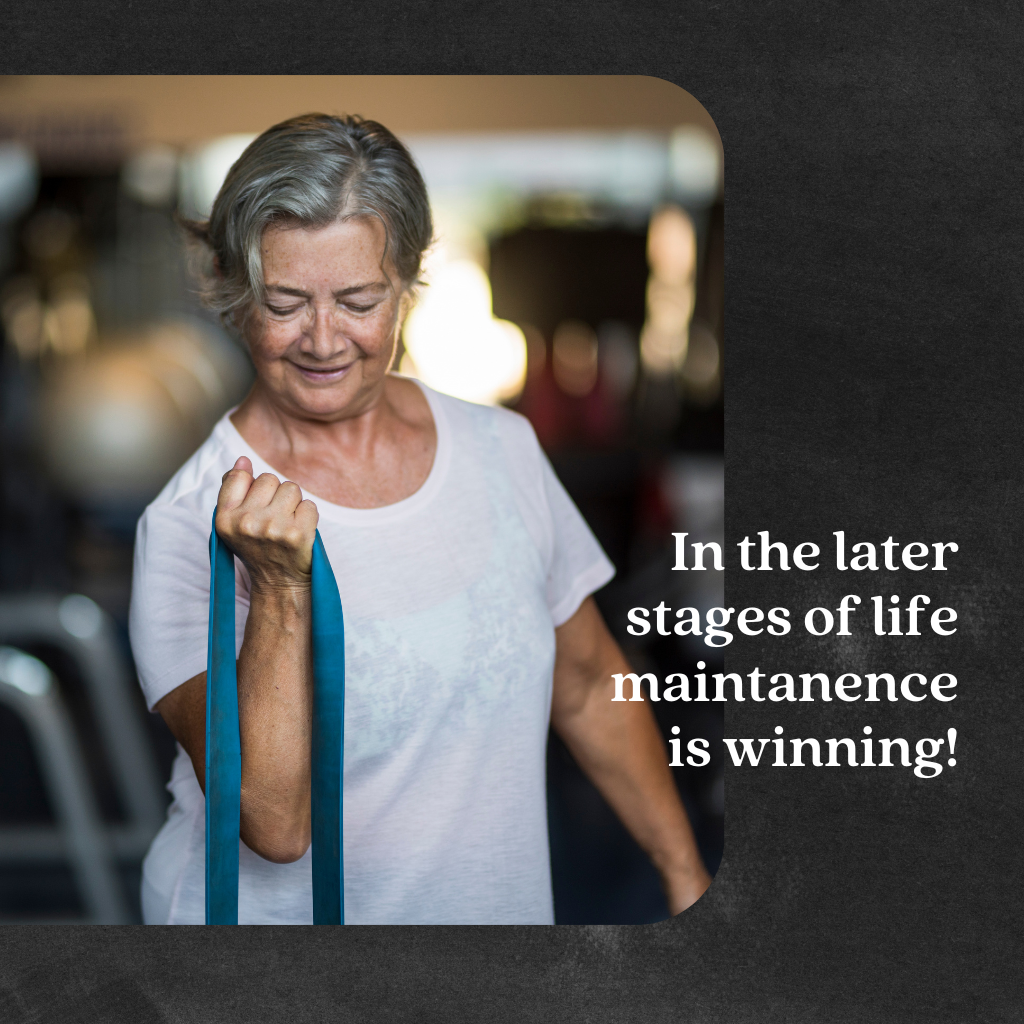
So even when we are past the age where new bone can be built... at the later stages of life... maintenance is winning!
The Question I Know You’re Carrying
I want to end with something that often gets left out of the strength training conversation.
Recovery.
Building bone and muscle doesn’t happen during the workout.
It happens afterwards... during rest, sleep, the quiet time when the body integrates the signals it received.
And this is especially important for those navigating exhaustion, burnout, illness, or low energy.
Because the question I hear is: if I can’t train at my usual level, am I losing bone?
It’s a great question.
And it deserves a proper answer.
That’s what part three is for... next week we’re going wider.
Nutrition, stress, sleep, breath, and what it looks like to care for your bones when life is hard and your capacity is reduced.
The answer is more hopeful than you think.
Listen to Episode 131 of Rooted in Presence wherever you get your podcasts. If you’d like to know exactly where your bones and body are right now, an Embodied Strength Profile Assessment is a great place to begin available online and in person at Still Space Hull.
And if you'd like to join a community of women in menopause getting strong in Hull, explore the Strong Bones Club 2 week trial here.


